
“[R]edesigning the Google logo is an impossible task without a perfect answer.” —Armin Vit

Google—it’s not just for (and by) engineers anymore. Slowly but surely, the search+ giant has come to the realization that design matters. This week, in the wake of a massive structural shift, the company unveiled a new logo (designed in-house). Reactions on Twitter ranged from the guttural—I hate it! I love it!—to the more nuanced; some saw Google’s effort as cynical, and others dubbed it “faux-naive.”
On the web, thoughtful analyses of the new mark didn’t tarry:
- Gerry Leonidas’s largely formal reading explains why the redesign fails: “The quirky modulated style [of the old mark] had…the benefit of disassociating the logo from any connotations of child-like lettering that the primary colors might suggest.”
- Tobias Frere-Jones offers a historical interpretation: “The old logo had a calligraphic origin, building every curve on a tilted axis. Without that supporting context in the rest of the word, this ‘e’ looks forced.”
- And Armin Vit’s take is pragmatic: “What’s important is that the new logo is exactly right and perfectly calibrated for what it needs to do.”
But maybe we’re spilling too much ink over this. After all, as Scott Jehl points out, “Google’s endorsement of the web as a home for apps (rather than just a place for linking to app stores) is bigger news than the logo update.” —Caren Litherland, editor
Your weekend reading
- Web animation expert Rachel Nabors has written up her reasoning for only speaking at conferences with a code of conduct. Her brave post addresses arguments that some organizers have mounted against offering a code of conduct, and explains why it’s a make-or-break option for many speakers. Her conclusion: there’s really no excuse for a conference not to have one. —Anna Debenham, technical editor
- The W3C is working on the preload specification that will allow user agents to preload resources using the <link> element. Typekit’s Bram Stein demonstrates how these preload hints can be used to optimize web performance when it comes to loading web fonts. Using preload hints, web developers can tell the browser to preload web fonts before it has finished downloading the HTML and all the CSS files; and fonts that are downloaded earlier will render sooner. —Michelle Kondou, developer
- Book cover designer, typeface designer, and Cooper Type grad Isabel Urbina Peña has launched YES, EQUAL, a database (plus commentary) whose goal is to close the gender gap in communication design. Urbina Peña hopes that the site will “make it easier for conference organizers to be more inclusive” and “little by little make room for equality in the creative world.” —Caren Litherland, editor
- It shocks me that half of the general public has low literacy. In a Contents post from 2012 that I find myself returning to again and again, Angela Colter does a fantastic job of showing that decisions around plain language, consistent design, and focused content have the ability to improve lives.—Aaron Parkening, project manager
- Last week, Salesforce relaunched their pattern library and it’s the most comprehensive digital style guide I’ve seen. It doesn’t just document their styles, it’s also educational, explaining the theory behind the designs, such as in their motion section. It’s a site I’ll be referencing a lot for inspiration. —Anna Debenham, technical editor
Your must-see hashtag
Overheard in ALA Slack
“you all are raising murderbirds, well done.”
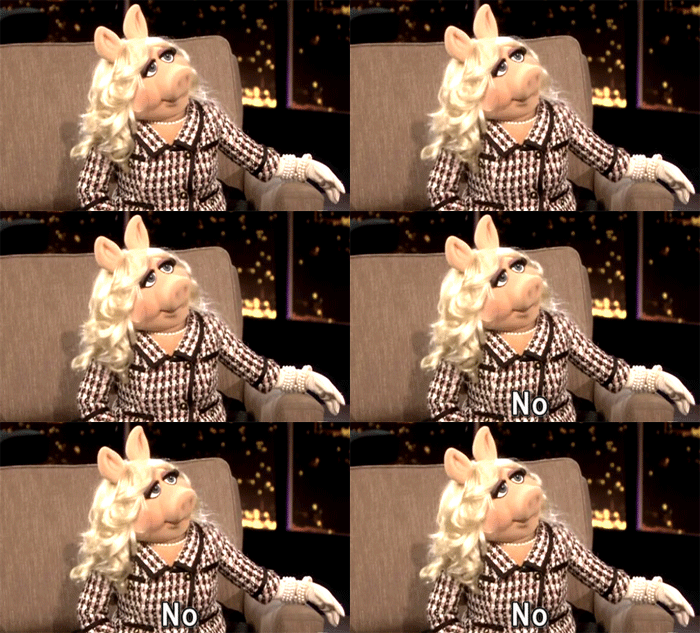
Your Thursday gif

No Comments
Got something to say?
We have turned off comments, but you can see what folks had to say before we did so.
More from ALA
Design for Amiability: Lessons from Vienna
Design Dialects: Breaking the Rules, Not the System
An Holistic Framework for Shared Design Leadership
From Beta to Bedrock: Build Products that Stick.
User Research Is Storytelling